Date:
Audience:
Topics:
Resource Type:

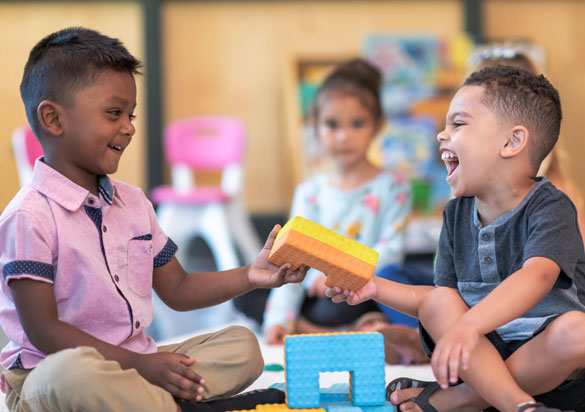
Research shows—and you have probably seen firsthand—how important it is for children to feel secure, valued, and cared about, and to develop strong social-emotional skills. As a Transitional Kindergarten (TK) teacher, you have the opportunity to play a vital role in children’s lives during a period of critical social-emotional growth.
Social-emotional development includes children’s experience, expression, and management of emotions; pro-social behaviors; classroom behaviors (e.g., paying attention); self-confidence; and their ability to establish positive and rewarding relationships with others. Current research shows that self-regulation of emotions and behavior is one of the strongest predictors of academic success and leads to success in the workplace, in social settings, and in life for all young school-aged children. Confident learners that stem from your classroom will have the foundational tools they need for continued success in school and beyond.
Social-emotional development consists of three main areas of children’s self-regulation:
Examples of behavioral self-regulation include:
Examples of emotional understanding and self-regulation include:
Examples of cognitive self-regulation include:
Teachers’ abilities to support social-emotional functioning in the classroom are central to effective classroom practice. The Classroom Assessment Scoring System (CLASS)™ for Pre-K describes measures of Emotional Support in a classroom climate that encourage positive social-emotional development and learning.
TK allows you the gift of time to move your students along the standards continuum, preparing them for a successful Kindergarten year ahead. As there are no set standards for TK, WestEd and the California Department of Education’s (CDE) Child Development Division developed a publication that aligns the Preschool Learning Foundations with the Kindergarten Common Core State Standards to help guide developmentally appropriate TK instruction. The alignment of the Preschool Learning Foundations and the Kindergarten Common Core State Standards illustrates the developmental progression of TK-aged students.
You can promote social-emotional development in your classroom by embedding your teaching practices throughout the day. Remaining sensitive to children’s needs helps them feel secure and confident, and acts as a model for effective social behavior. For example, asking questions to help children find a solution to a social conflict helps them develop problem-solving skills. Reading a story and engaging children in a conversation about a socially challenging situation can also serve as a lesson in handling social problems in real-life as well as in literacy.
Be attentive to the social-emotional skills and needs of each unique child so you can respond with lessons and interventions tailored to help every child develop their skills. Your attention and presence as a teacher can be a pillar of confidence for children who are dealing with stressful life circumstances. Letting children know that you are there to help will build children’s trust that you are a source of guidance. Keep in mind that children who are Dual Language Learners (DLLs) may need additional support to feel secure and self-assured in a learning environment that is responsive to their needs.
Recognize that the emotional domain is foundational to all other developmental domains. If children start school in an emotionally supportive environment, they will acquire the love of learning necessary for success in all areas of the school. “As young children develop, their early emotional experiences literally become embedded in the architecture of their brains,” therefore great care should be given to children’s emotional needs, according to the National Scientific Council on the Developing Child. If you seek children’s opinions, allow children to initiate activities, and are flexible about responding to children’s ideas, you’ll build children’s feelings that they are competent and respected, and at the same time motivate their desire to learn.
Social-emotional development is supported through positive and consistent relationships among teachers and children. Try going beyond expectations of compliance with school rules, and support social-emotional development by crafting a positive, emotionally supportive climate in the classroom that skillfully connects new experiences with children’s unique home experiences. According to the National Scientific Council on the Developing Child, “Children who develop warm, positive relationships with their [TK] teachers are more excited about learning, more positive about coming to school, more self-confident, and achieve more in the classroom.”

The teaching strategies below give concrete approaches for promoting social-emotional development in your classroom. They are designed to guide developmentally appropriate TK instruction, moving your students along a continuum of learning by bridging the Preschool Learning Foundations with the Kindergarten Common Core.
Strategy 1: Relationships and Social Interactions with Peers
Strategy 2: Social and Emotional Understanding
Strategy 3: Conflict Negotiation (Problem Solving)
Strategy 4: Child Regulates Emotions and Behaviors
Strategy 5: Engagement and Persistence
Strategy 6: Responsible Conduct
Strategy 7: Integrated Approaches for English Language Development and Family Engagement
Click the button below to download the teaching strategies (PDF).
Note: The information on this page was provided by the Social-Emotional Development Domain of the California Infant/Toddler Learning & Development Foundations. (California Department of Education).